The Blanford's Fox Conservation Project: Protecting One of the UAE's Most Elusive Mountain Species
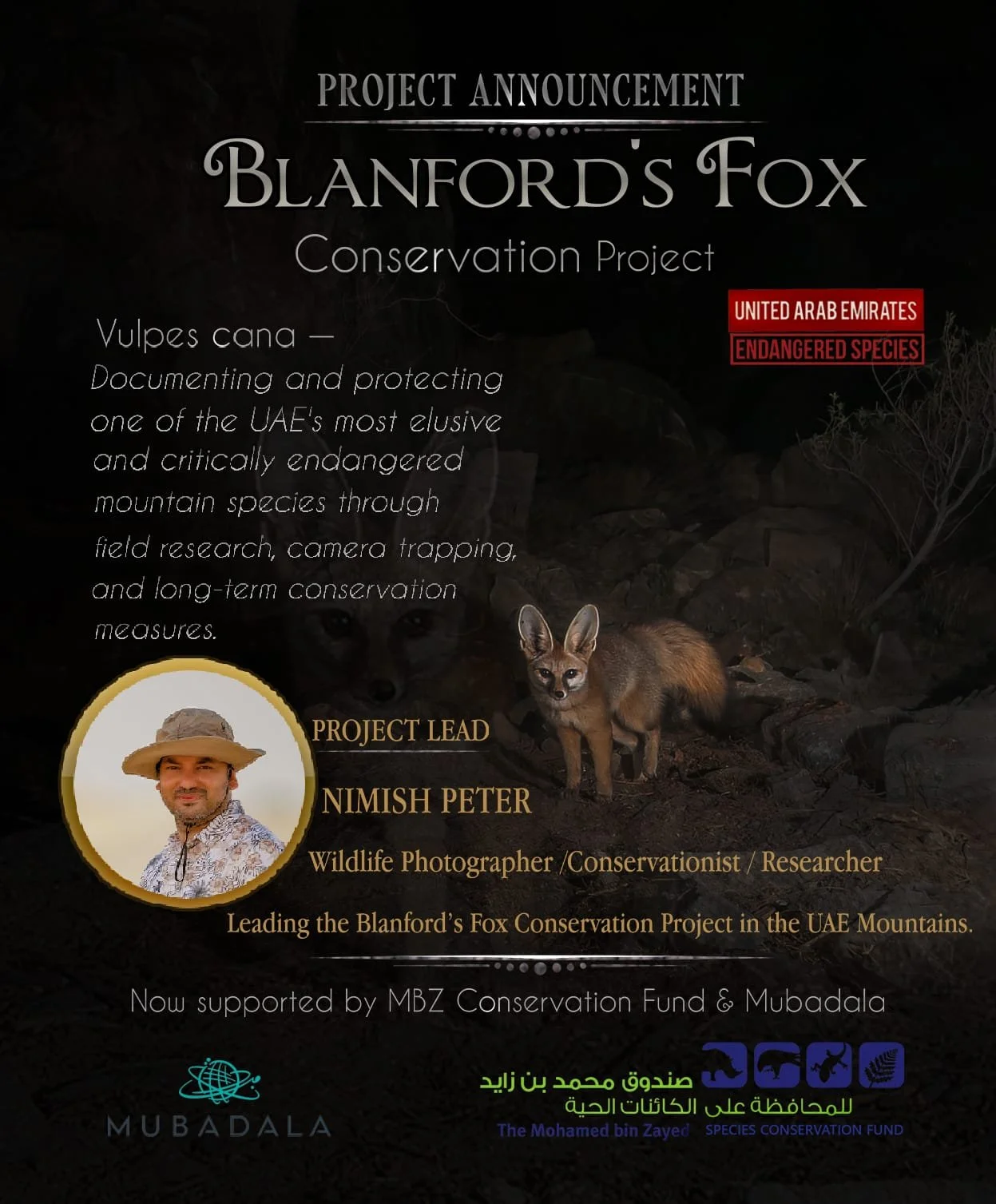
Blanford’s fox - Announcement Posture
High in the rocky folds of the UAE's mountains lives a fox most people in the Emirates will never see. It moves only after dark, scales near-vertical cliffs with ease, and has been recorded so rarely that each sighting makes the news. This is the Blanford's fox — and protecting it is the focus of a conservation project I am proud to be leading.
Announcing the Blanford's Fox Conservation Project
I am excited to share the launch of the Blanford's Fox Conservation Project, an initiative dedicated to documenting and protecting Vulpes cana, one of the UAE's most elusive and least-understood mountain mammals. Through field research, camera trapping, and long-term monitoring, the project aims to build a clearer picture of how this remarkable little fox survives in the Emirates — and what it needs from us to keep surviving.
I a'm honoured that the project is now supported by the Mohamed bin Zayed Species Conservation Fund and Mubadala, two organisations whose backing makes serious, sustained fieldwork possible.
Meet the Blanford's Fox (Vulpes cana)
The Blanford's fox is a small, cat-like canid named after the English naturalist William Thomas Blanford, who first described the species in 1877. In Arabic it's known as the Royal fox, and once you've seen one, the name fits.
A few things make it unmistakable:
It's tiny. Among the world's foxes, only the fennec is smaller. An adult weighs roughly 1.5 to 3 kg, with a body around 40–50 cm long.
The tail is extraordinary. Long, thick and bushy, it's almost as long as the fox's entire body. The fox uses it as a counterbalance, which is how it pulls off the climbing and leaping that other foxes simply can't.
The ears are oversized. Wide and prominent, they help the fox shed heat in its arid mountain home.
It wears a mask. Soft brownish-grey fur, a pale yellow belly, a dark stripe running down the spine, and distinctive dark facial markings give it an almost painted appearance.
Unusually for a fox, the Blanford's fox is one of the very few that regularly climbs — scaling steep cliffs and canyon walls as comfortably as it crosses open ground.
A Creature of the Night and the Mountains
The Blanford's fox is strictly nocturnal, emerging shortly after dusk and remaining active through the night — an adaptation that helps it avoid daytime predators like raptors. It lives almost exclusively in mountainous terrain: steep rocky slopes, dry creek beds, canyons and cliffs, typically below 2,000 metres in elevation.
It's also largely solitary. Pairs are thought to be monogamous, each holding a territory of roughly 1.5 square kilometres, but even mated pairs tend to forage alone. Its diet is mostly insects and fruit, and remarkably, it drinks very little water — drawing most of what it needs from its food.
This combination of traits — nocturnal, solitary, mountain-dwelling, and naturally shy of open ground — is exactly what makes the species so hard to study, and so rarely seen.
How Rare Is It in the UAE?
Here's where the story becomes urgent. Globally, the Blanford's fox is listed as Least Concern by the IUCN, because across its full range — from Iran and Afghanistan to Pakistan, Oman, Saudi Arabia and beyond — it remains relatively widespread in mountainous country.
But within the UAE, the picture is very different. The fox is considered locally endangered, simply because confirmed sightings are so few and far between. On Jebel Hafeet near Al Ain, it was recorded just a handful of times across more than two decades — captured on a camera trap in 2019 after not having been seen since the late 1990s. It has also been documented in the Western Hajar Mountains of Ras Al Khaimah.
Each of those records represents enormous patience, and a fair amount of luck. That scarcity of data is precisely the problem this project sets out to solve.
The Threats It Faces
For a species this rarely seen, even small pressures matter. The main challenges to the Blanford's fox in the UAE include:
Feral dogs and cats, which compete for food and habitat and can transmit disease — a particular danger to a small-bodied species.
Habitat disturbance, as human activity pushes further into the quiet mountain areas the fox depends on.
Lack of data, which sounds less dramatic than the others but is just as serious. You cannot protect what you haven't measured, and we still know very little about how this fox lives in the Emirates specifically.
What the Project Is Doing
The Blanford's Fox Conservation Project focuses on three pillars:
Field research. Systematic surveys in the UAE's mountain habitats to map where the fox is present and understand the conditions it favours.
Camera trapping. Because the fox is nocturnal and elusive, motion-triggered cameras are the single most effective way to confirm its presence, monitor individuals, and observe behaviour without disturbing it.
Long-term conservation measures. Turning the data we gather into practical protection — identifying key habitats, understanding threats like feral predators, and supporting the case for safeguarding the quiet mountain corridors this species needs.
Why It Matters
It would be easy to overlook a fox that almost nobody ever sees. But the Blanford's fox is part of what makes the UAE's mountains wild. Its presence is a sign of a functioning ecosystem, and its quiet disappearance would be a loss most people would never even notice — which is exactly why it deserves a voice.
Through photography and fieldwork, my hope is to bring this hidden animal into view: to show people that the Arabian mountains hold creatures every bit as remarkable as those found anywhere on Earth, and that they're worth protecting.
This is just the beginning. I will be sharing updates from the field, camera-trap discoveries, and images as the project develops. Follow along — and help me make sure the Royal fox of the Emirates has a future.
The Blanford's Fox Conservation Project is led by wildlife photographer and researcher Nimish Peter, with the support of the Mohamed bin Zayed Species Conservation Fund and Mubadala.
To explore more of the UAE's wildlife — including reptiles, mammals, birds and desert fauna — visit the galleries at nimishpeter.com.